
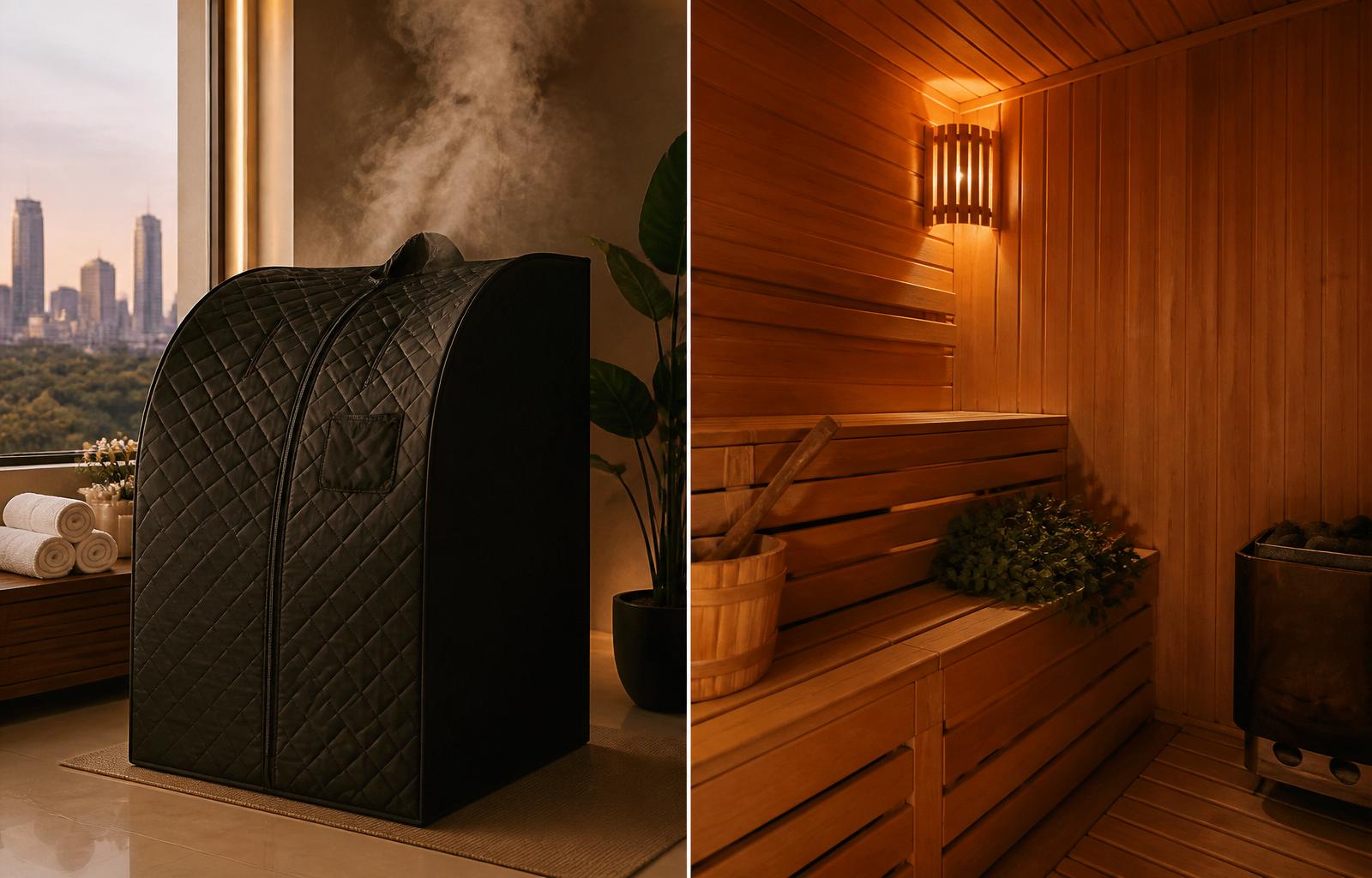
People often ask whether dry sauna is better than steam sauna because dry sauna runs hotter. The honest answer: not necessarily.
Dry sauna and steam sauna create different types of heat stress. One is not automatically better for everyone. The better choice depends on comfort, safety, consistency, space, budget and how you want to use it.
The basic difference
| Type | Temperature | Humidity | Notes |
|---|---|---|---|
| Dry sauna | 70–100°C | Low | Usually a wooden cabin. Stronger long-term research base. |
| Steam sauna | 40–60°C | Very high | Feels intense because sweat evaporates less. Easier portable setup. |
| Infrared | 45–65°C | Low | Radiant heat. Different mechanism from traditional sauna or steam. |
Why steam can feel hotter at a lower temperature
Sweating cools the body when sweat evaporates. In a steam sauna, the air is humid, so sweat does not evaporate as easily. That can make the session feel hotter and more enveloping even though the air temperature is lower than a dry sauna.
This is why steam sauna is often experienced as more humid, more respiratory-feeling, more skin-warming, more spa-like and more relaxing for some users. Dry sauna often feels sharper, hotter, drier, more traditional, and easier to tolerate for others because evaporation still happens.
Which one has stronger science?
Traditional dry sauna has more long-term published research, especially from Finland. Many of the famous cardiovascular studies are based on Finnish dry sauna habits. Steam sauna has less long-term outcome research, but it still creates heat exposure, sweating, relaxation and circulation response.
Dry sauna has more long-term research. Steam sauna may be more practical, affordable and consistent for many homes and spas in Kenya.
Which one is better for businesses?
For a spa, salon, massage room or small wellness center, steam sauna can be easier to add. A traditional dry sauna may require construction, electrical work, a dedicated room, larger upfront cost, permanent installation and more space.
A portable steam sauna can be bought once, set up quickly, moved if needed, offered as an add-on service, and used in an existing treatment room. This is why steam sauna is attractive for Nairobi spas, salons, lodges, Airbnbs and wellness businesses.
How long should you stay in each?
| Level | Steam sauna | Dry sauna |
|---|---|---|
| Beginner | 5–10 minutes | 5–10 minutes |
| Regular | 10–20 minutes | 10–20 minutes |
| Advanced | Up to 20 minutes | 15–25 minutes |
Sauna should not be a suffering contest. Leave before symptoms become intense. Because dry saunas can be much hotter, users should be careful not to copy advanced Finnish sauna routines without adaptation.
What benefits do people use saunas for?
People commonly use heat sessions for relaxation, sweating, muscle looseness, perceived recovery, stress relief, circulation response, sleep routine, spa experience and breath-focused calming. The strongest cardiovascular association data comes from sauna frequency studies (see our sauna frequency guide), but no sauna should be marketed as a cure.
NiceBaths recommendation
For most Kenyan homes and small businesses, steam sauna is the practical winner. Not because it is scientifically superior in every way, but because it is easier to install, easier to move, easier to offer as a service, more affordable and suitable for home or spa use. The best sauna is the one people actually use. Browse our products or contact us about business setups and workshops.
Safety note
Heat exposure is powerful. Hydrate well. Avoid alcohol. Stop if dizzy, faint, overheated, confused, nauseous or short of breath. Ask a medical professional first if you have heart disease, uncontrolled blood pressure, pregnancy, heat intolerance or serious medical conditions.
Want the benefits of a sauna without construction?
Explore NiceBaths portable steam sauna tents for homes, spas, lodges and wellness businesses in Kenya.
See sauna tents →Frequently asked questions
Is dry sauna better than steam sauna?+
Not automatically. Dry sauna has more long-term research, but steam sauna can be easier and more practical to use consistently.
Does steam sauna get hot enough?+
Yes. Steam sauna can feel intense even at lower temperatures because humidity is high.
Is steam sauna good for spas?+
Yes. It can be added as an extra paid service without building a permanent sauna room.
Can steam sauna be used at home?+
Yes. Portable steam sauna tents can be used in a suitable room or sheltered space with ventilation and safe power setup.
Which sauna is better for beginners?+
Many beginners prefer steam sauna because the ritual feels softer and spa-like, but some prefer dry sauna because sweat evaporates better. Start short either way.
Sources
- Laukkanen T, Khan H, Zaccardi F, Laukkanen JA. "Association Between Sauna Bathing and Fatal Cardiovascular and All-Cause Mortality Events." JAMA Internal Medicine, 2015. DOI: 10.1001/jamainternmed.2014.8187
- Hannuksela ML, Ellahham S. "Benefits and risks of sauna bathing." American Journal of Medicine, 2001. DOI: 10.1016/S0002-9343(01)00834-8
- Kunutsor SK, Laukkanen JA. "Sauna bathing and systemic inflammation." European Journal of Epidemiology / KIHD sauna research.
Not sure where to start?
Unsure which setup is right for you?
Take the 60-second recovery quiz for a personalized plan.
Take the 60-second recovery quiz →Talk to NiceBaths
Questions about “Steam Sauna vs Dry Sauna: Which Heat Experience Is Better?”?
Message us on WhatsApp — your note is pre-filled with a reference to this article so we can help you faster.
WhatsApp NiceBaths about this article